 spokt
spoktLearner guide
How Many Hours of Comprehensible Input to Learn a Language
How many hours of comprehensible input to learn a language depends mostly on distance: for a close language like Spanish, expect roughly 50 hours before simple content clicks, 600 to follow normal speech, and 1,000–1,500 to feel genuinely comfortable — with Japanese, Korean, or Arabic taking about two to four times longer. Those numbers come from the Dreaming Spanish roadmap and FSI classroom data, mapped below to CEFR levels with the caveats that actually matter. This guide also covers the part most articles skip: how to track those hours without babysitting a spreadsheet.
How Many Hours of Comprehensible Input You Need, Level by Level
The most cited framework is the Dreaming Spanish roadmap, built around Spanish for English speakers. It splits the journey into seven levels and attaches an hour count to each. If the method itself is new to you, start with our guide to what comprehensible input is and how it works — the short version is that you acquire a language by reading and listening to material you mostly understand, and the hours below are hours of exactly that.
| Input hours | What you can actually do | Rough CEFR comprehension |
|---|---|---|
| 50 | Recognize common words; follow content made for absolute beginners | A1 |
| 150 | Follow adapted learner stories and podcasts on familiar topics | A2 (emerging) |
| 300 | Understand a patient native speaker talking directly to you | A2–B1 |
| 600 | Understand people speaking to you at normal speed; easy native content opens up | B1 |
| 1000 | Comfortable with daily conversation and most native content on familiar topics | B1–B2 |
| 1500 | Effective user: shows, books, and work conversations, with gaps at the edges | B2 |
Two honest caveats. First, Dreaming Spanish levels are not CEFR levels: CEFR grades speaking and writing too, while these hours measure comprehension. Read the right-hand column as comprehensible input hours by CEFR level for listening and reading only — your speaking will lag until you start using the language. Second, the curve is not linear. Each level costs more than the last, and going from solid B2 comprehension to C1–C2 can take roughly as many hours as everything that came before it.
Input Hours vs. Classroom Hours: What the Research Says
If 1,500 hours sounds like a lot, compare it with classroom numbers. The US Foreign Service Institute estimates that professional working proficiency in Spanish or French takes roughly 600–750 classroom hours — intensive instruction, with homework on top, for selected full-time learners. For its hardest group (Arabic, Mandarin, Japanese, Korean) the estimate is about 2,200 classroom hours. Seen against that, 1,000–1,500 hours of enjoyable input is not slow; it is the normal cost of a language, paid in stories and podcasts instead of drills.
There is also evidence that input hours convert better than instruction hours. A three-year study by Beniko Mason and Nobuyoshi Ae at a Japanese junior high school found that students who received about 70 hours of comprehensible input scored as well on final tests as peers who received about 286 hours of traditional instruction. It is one study in one context, so hold it loosely — but it points the same direction as decades of extensive-reading research: time spent understanding messages beats time spent studying rules.
Adjust for Language Distance: The FSI Multipliers
The milestone table is calibrated for English speakers learning Spanish. Language distance changes the bill, and the FSI category ratios give a workable rule of thumb:
- Close languages — Spanish, French, Italian, Portuguese, Dutch: use the table as-is.
- Mid-distance languages — German runs slightly over; Russian, Turkish, Hindi, Vietnamese, and Finnish need roughly 1.5–2× the hours.
- Distant languages — Japanese, Korean, Mandarin, Arabic: budget roughly 3–4×. FSI's classroom estimate for these is about three times its estimate for Spanish.
Distance is measured from the languages you already know, so discount if you have a head start — a Spanish speaker gets Portuguese far cheaper than the table suggests. One more wrinkle for distant languages: listening hours transfer fully, but reading in a new script (Japanese kana and kanji, the Arabic abjad) has its own on-ramp, so your early reading hours accumulate more slowly than your listening hours.
What Counts as an Hour of Input — and Why "Fluent in 3 Months" Fails
An input hour is time spent actually understanding messages in the language. Three tests: you were paying attention, you understood most of it (the classic "i+1" sweet spot — comprehensible, with a little stretch), and it was real connected language rather than isolated vocabulary. Background audio while you answer email fails the first test — count it at a steep discount or not at all. Content far above your level fails the second: you cannot acquire from noise, no matter how many hours you log.
Reading counts. Reading while listening to the same text is one of the densest forms of input there is, because the audio anchors pronunciation and pace while the text disambiguates every word — it is the core of the approach in our guide to learning a language with audiobooks.
The table also explains why "fluent in three months" marketing fails simple arithmetic. Reaching 1,000 hours in 90 days means eleven hours of focused input every single day. At a sustainable one hour a day you reach 600-hour comprehension in under two years; at two hours a day, under one year. Slower than the ads promise, far faster than a decade of on-and-off streak apps.
How to Track Your Language Learning Hours
Tracking matters more than it looks. Progress with an input-based approach is invisible day to day — you notice it across months, not sessions — and the running hour count is what carries you through the flat stretches, especially the intermediate plateau. Most learners track manually: a spreadsheet with date, activity, and minutes; a notes file; or Dreaming Spanish's built-in tracker, with manual entries for anything watched or read elsewhere.
Manual tracking has one failure mode: friction. You forget to log the podcast from the commute, estimate generously ("that was probably an hour"), and eventually stop logging altogether — usually right when the count matters most. The fix is to make the counter passive. If the app you read and listen in measures your time itself, the log is exact, honest, and effortless — and that is precisely what Spokt's hours-of-input dashboard does.
How Spokt Counts Your Input Hours Automatically
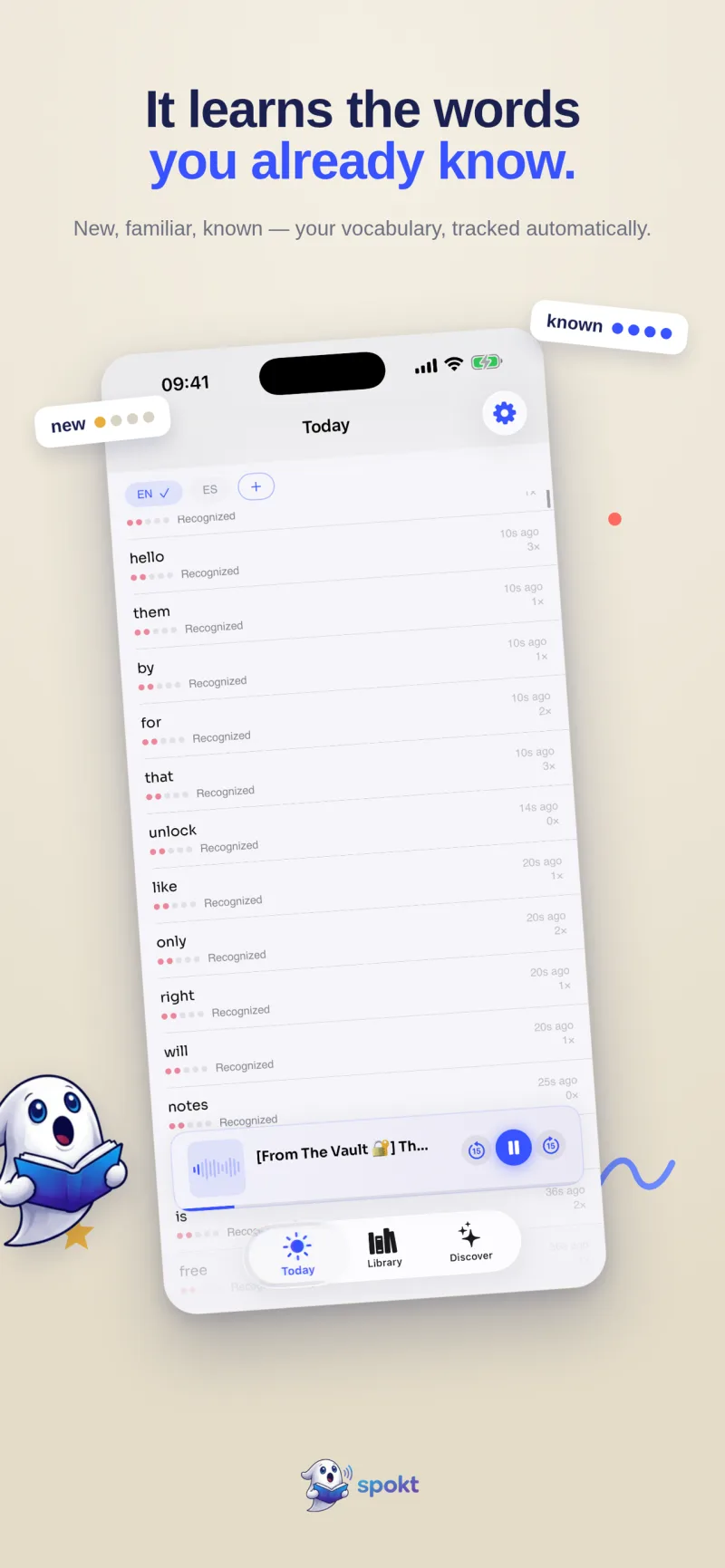
Spokt is a free iOS app built around exactly this method: a Discover feed of real stories, podcasts, and news leveled A1–C2, word-synced audio for anything you import, and a dashboard that counts your hours of comprehensible input while you read and listen.
- Download Spokt and switch on Learner ModeSpokt is free on the App Store for iPhone and iPad. Pick Learner (or Both) and the app reshapes itself around language learning.
- Take the quick placement checkA short check estimates your level, so the Discover feed serves stories, podcasts, and news pitched at your A1–C2 band — the i+1 sweet spot, found for you.
- Read and listen to things you actually enjoyChoose from the Discover feed or import your own PDFs, EPUBs, articles, and MP3/M4B audiobooks. Word-by-word karaoke highlighting keeps your eyes and ears in sync.
- Make hard input comprehensibleSlow playback to 0.75×, loop a tricky sentence in immersive mode, and tap any word for an instant on-device translation without leaving the page.
- Watch the hours dashboard climbEvery minute you spend reading and listening is counted toward your hours of comprehensible input automatically — no spreadsheet, no timer. Vocabulary moves new → familiar → known as you go, with optional FSRS review built from words you actually met.
Frequently asked questions
How do I track language learning hours without an app?
A simple spreadsheet works: one row per session with the date, the activity, and honest minutes, plus a weekly total. Dreaming Spanish users can log outside content in its built-in tracker. The two rules that keep a manual log meaningful are logging the same day (memory inflates estimates fast) and discounting background listening rather than counting it at full value. If the friction of logging makes you quit, switch to an app that counts your time passively while you read and listen.
Do comprehensible input hours map cleanly to CEFR levels?
Only approximately. CEFR measures four skills — including speaking and writing — while input hours build comprehension first, so a learner with 600 hours may test B1 in listening but lower in production. As rough anchors for close languages: around 600 hours corresponds to B1-level comprehension and around 1,500 hours to B2-level comprehension, with C1–C2 taking disproportionately longer. If you need a certificate, add deliberate speaking and writing practice on top of your input.
Does reading count toward comprehensible input hours?
Yes — reading is comprehensible input in written form, and most hour-tracking frameworks count it alongside listening. Reading while listening to the same text is especially efficient because the audio carries pronunciation and rhythm while the text makes every word unambiguous; see our guide to learning a language with audiobooks for the full read-along workflow.
Can I learn a language with 30 minutes a day?
Yes, if you accept the timeline the arithmetic implies. Thirty minutes a day is about 180 hours a year, which in Spanish puts you at the 150-hour milestone within a year and approaching the 300-hour milestone in two — real, noticeable progress, just not fluency. Consistency beats intensity: a sustainable half hour daily outperforms weekend binges you abandon by March, and for distant languages like Japanese or Arabic, multiply the timeline by roughly three to four.