 spokt
spoktLearner guide
How to Actually Learn a Language by Listening to Audiobooks
You can learn a language by listening to audiobooks — but not by letting them play in the background. In the best-known controlled study on this, learners who only listened could translate just 2% of the new words afterward, while learners who read the text as they listened retained roughly eight times as much. The method that works is reading along while you listen, and you can do it with any audiobook you own.
Can you learn a language by listening to audiobooks alone?
This exact question has been put to the test. In 2008, researchers Brown, Waring, and Donkaewbua gave learners of English the same graded stories in three modes — reading only, reading while listening, and listening only — then measured vocabulary immediately afterward, a week later, and three months later. The gap between modes was dramatic. On the easiest test, simply recognizing a word's meaning, the listening-only group picked up about 29% of the target words, versus 48% for the reading-while-listening group. On the stricter test — producing a translation — listening alone yielded just 2%: about half a word out of 28. Three months later, the listening-only group could translate barely 1% of them.
The reason is mechanical, not motivational. Speech is a continuous stream with no spaces in it. If you don't already know where words begin and end, an unknown word isn't a learning opportunity — it's a blur that washes past at 150 words per minute. Written text anchors the stream: your eyes segment the sentence, your ears attach a sound to each written form, and an unfamiliar word becomes something you can notice, look up, and recognize the next time.
Two takeaways follow. First, mode matters: pair the audio with its text and you learn vocabulary at roughly the rate of reading while also training your ear. Second, volume matters: even in the best mode, most new words were not learned from a single story — words met 15–20 times stuck at well over twice the rate of words met only two or three times. That is the core argument for comprehensible input: large amounts of material you mostly understand, met repeatedly, over months.
The listening-reading method: eyes on the text, ears on the audio
Language learners have been formalizing this idea for two decades as the listening-reading method, usually shortened to L-R. The core move is simple: press play on the audiobook and follow the full text with your eyes while the narration sets the pace. You never pause to sound words out, and you never let the audio run without the text in front of you.
There are two classic variants. Read-along — target-language audio with target-language text — is the version the research above supports, and the right default from roughly A2 upward. Classic L-R goes a step further for beginners: you follow a translation in your own language while the target-language audio plays, then switch to the target-language text on a second pass. It's demanding, but it's how some forum polyglots work through full novels from near zero.
Either way, the method trains four things passive listening can't: hearing word boundaries in connected speech, linking spelling to sound (crucial in languages like French or English where the two diverge), processing at the narrator's speed instead of your inner reading voice's, and simply holding your attention on the language for an hour at a time.
The catch has always been tooling. Amazon's Whispersync for Voice pairs a Kindle ebook with its Audible audiobook, but you must buy both formats, only a subset of titles support it, and you're limited to Amazon's catalog. Apps like Beelinguapp bundle bilingual side-by-side texts with audio, but only from their own library. If the audiobook you want to learn from is an MP3 or M4B you already own, you need an app that can sync your files itself — a landscape we compare in detail in our guide to reading along with your own audiobooks.
Choosing audiobooks at the right level — and where to find them
The biggest predictor of whether any of this works is comprehensibility. If you understand well under about 90% of what you hear while reading along, the book is too hard — you'll be decoding instead of acquiring, and you'll quit by chapter three. Drop down a level without guilt.
| Your level | What to listen to | Why it works |
|---|---|---|
| A1–A2 | Graded/learner audiobooks, slow-news podcasts | Controlled vocabulary keeps you near full comprehension |
| B1 | Children's chapter books, translations of stories you already know | Simple prose plus a plot you can predict |
| B2 and up | Contemporary novels, narrative nonfiction, native podcasts | Real language at natural speed, chosen by interest |
The "familiar story" trick deserves its reputation: a translation of a novel you've already read in your own language — Harry Potter is the perennial example, available in dozens of languages — gives you the plot for free, so your working memory can spend itself entirely on the language.
For sources: LibriVox offers free, volunteer-read audiobooks of public-domain books in dozens of languages, and each recording links to its free source text — a ready-made read-along pair, with the caveats that the texts skew old-fashioned and narration quality varies by volunteer. Graded-reader publishers sell book-plus-audio bundles for A1–B1 learners. Podcasts with published transcripts are the richest source for smaller languages, where commercial audiobook catalogs thin out fast; learners of Spanish, French, German, and Portuguese have the widest choice of everything.
Active-listening techniques that make the hours count
Reading along is the foundation; a few habits multiply what each hour returns:
- Slow the narration to about 0.75×. Slightly slower audio buys decoding time while keeping natural rhythm — and speeding back to 1× a few chapters later feels like a genuine comprehension upgrade.
- Loop sentences you almost caught. Replaying one hard sentence two or three times pays far better than replaying a whole chapter.
- Look up blockers, let the rest go. Check a word only when not knowing it breaks the meaning of the passage. Chasing every unknown word kills the volume that makes input work.
- Close the book and summarize. After each chapter, retell what happened aloud in the target language for a minute — retrieval locks in what exposure started.
Passive listening does have a place — just a narrow one. Relistening to a chapter you've already read along with turns a commute into real review, because the audio is now comprehensible on its own. Background listening to content you already understand 90%+ tunes your ear for rhythm and pronunciation. What the research rules out is the tempting version: playing an audiobook far above your level while doing something else and hoping the language seeps in. It doesn't.
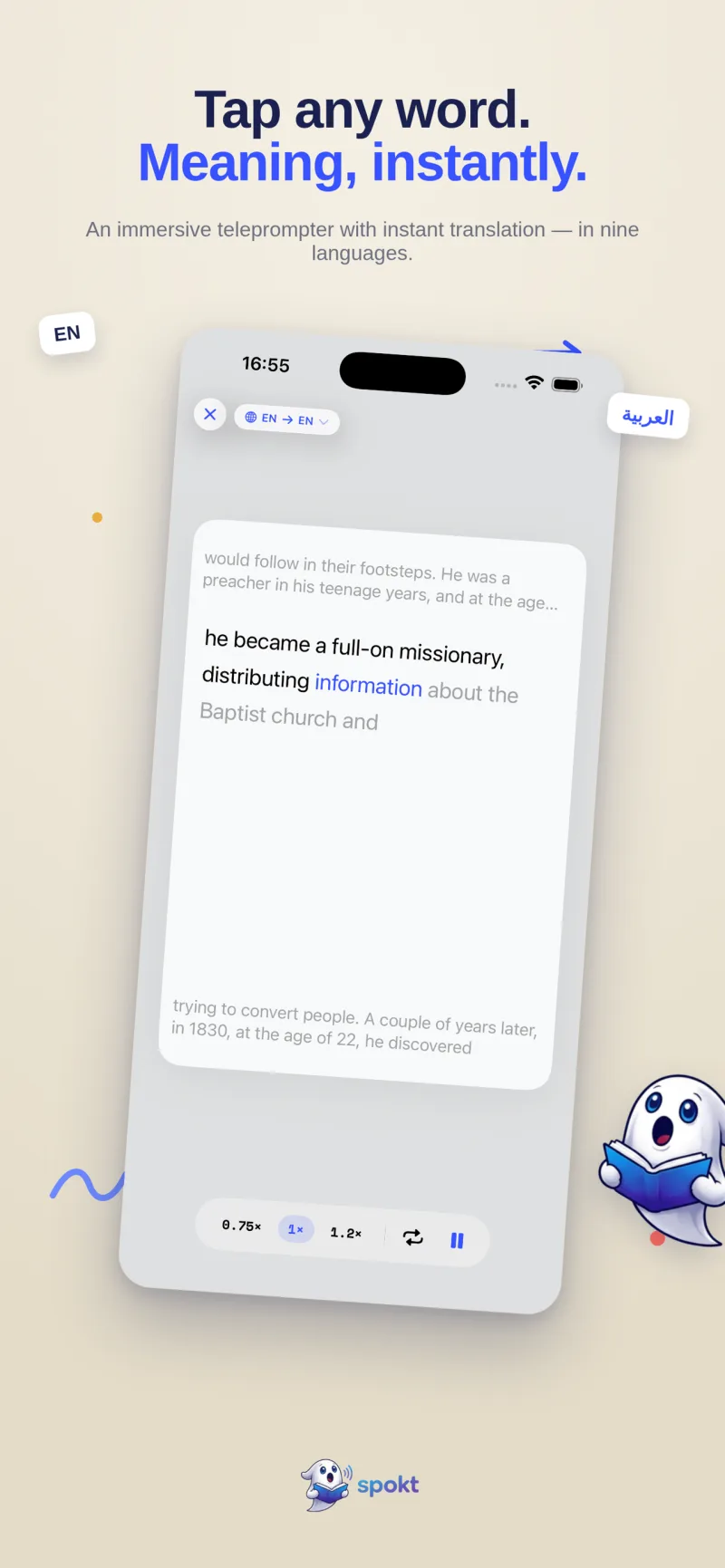
How to read along with any audiobook in Spokt
Everything above traditionally requires Amazon's ecosystem, a paper book on your lap, or manual syncing. Spokt, free on iPhone and iPad, runs the whole workflow with audiobook files you already own:
- Import your audiobookAdd your MP3 or M4B files to Spokt — share them straight from the Files app, or pick files or a folder; multiple files become one book with chapters, and M4B chapter markers are picked up automatically.
- Attach the original textAdd the companion PDF or EPUB, and the full original book is one tap away from the player via View Original PDF.
- Press play and follow the highlightSpokt syncs the text to the narration with word-by-word karaoke highlighting, so your eyes never lose the narrator's place.
- Slow down and loopDrop playback to 0.75× while your ear adjusts, and use sentence loop in the immersive teleprompter mode to replay lines you almost caught.
- Tap words you don't knowAny word gives you an instant on-device translation without leaving the page — and the app itself ships in 10 languages, including right-to-left Arabic.
- Let Learner Mode measure itEvery word you read and hear moves from new to familiar to known automatically, your listening feeds an hours-of-input dashboard, and optional spaced-repetition review is built from words you actually encountered.
Frequently asked questions
Where can I find audiobooks for language learning with text included?
Graded-reader publishers sell book-plus-audio bundles pitched at specific CEFR levels, which is the easiest starting point. For free material, LibriVox hosts volunteer-read recordings of public-domain books in dozens of languages, and each recording links to its free source text — a ready-made read-along pair. Many podcasts also publish full transcripts. And if your audio and text are separate files, our guide to reading along with your own audiobooks covers how to sync them word by word.
Does the listening-reading method work for complete beginners?
It's hardest at the very start, because almost nothing is comprehensible yet. Two adaptations help: begin with graded audiobooks written for A1–A2 learners instead of real novels, or use the classic L-R variant where you follow a translation in your own language on the first pass. Spokt's quick placement check and its Discover feed of stories, podcasts, and news leveled A1–C2 exist for exactly this problem — finding audio you can mostly understand on day one.
Can I use my Audible or Kindle books in a third-party read-along app?
No — Audible and Kindle purchases are DRM-protected and only open in Amazon's own apps, where read-along (Whispersync for Voice / immersion reading) works only if you buy both formats of a supported title. Third-party read-along apps need DRM-free files: MP3 or M4B audio you own outright, such as LibriVox downloads, DRM-free store purchases, or rips of audiobook CDs you bought.
How many hours of audiobook listening does it take to learn a language?
Hundreds, honestly. Roadmaps popularized by the comprehensible-input community put comfortable understanding of everyday speech at roughly 600–1,000 hours of input for a language close to English, and a multiple of that for distant languages like Japanese or Arabic. The good news is that audiobooks are one of the densest ways to accumulate those hours — our guide on how many hours of comprehensible input you need breaks the milestones down level by level.